
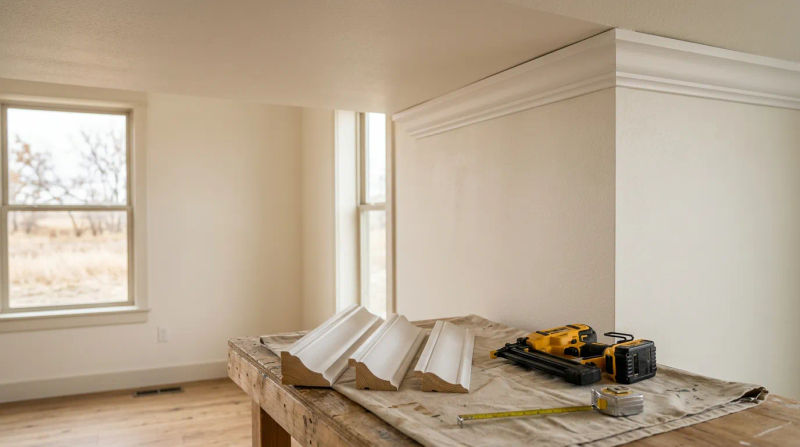
When you start thinking about adding a touch of elegance to your home, crown molding is often one of the first things that comes to mind. It’s a classic upgrade that can dramatically change the feel of a room, adding character and a sense of completeness. As the owner of a local finish carpentry business, I know the first question on everyone's mind is, “What’s this going to cost me?” It’s a fair question, and my goal here is to give you a transparent, straightforward look at the real costs involved.
Especially as the cold settles in here in Fleming and we start spending more time indoors, many homeowners begin planning those winter projects. Getting a clear idea of your budget now is the perfect first step. Let’s break down the numbers so you can plan with confidence.
Average Costs in Fleming
It’s tough to give a one-size-fits-all price, but I can provide a realistic range for what you can expect for a professional crown molding installation Fleming CO price. Most contractors, myself included, price crown molding by the linear foot, which includes both labor and materials.
In our area, you can generally expect the total installed cost to range from $7 to $15 per linear foot.
So, what does that look like for a typical room? Let’s calculate the cost to add crown molding in living room that measures 12 by 15 feet. That room has 54 linear feet of wall space.
- On the lower end (using a simple, paint-grade material like MDF): 54 ft. x $7/ft. = $378
- On the higher end (using a more complex profile or a stain-grade wood): 54 ft. x $15/ft. = $810
For a standard living room in Fleming, you can realistically budget between $400 and $900 for a complete, professional installation. This range covers everything from a basic, clean look to something more decorative.
Factors That Affect Price
That price range is a good starting point, but several factors can shift the final crown molding cost. Understanding these variables will help you see where your money is going.
1. The Crown Molding Labor vs Materials Breakdown
The two biggest components of your estimate are materials and labor. The material you choose has the most significant impact on the material cost.
- MDF (Medium-Density Fiberboard): This is the most budget-friendly option. It’s smooth, easy to paint, and stable. However, it’s not suitable for staining and can be susceptible to water damage, making it a poor choice for bathrooms.
- Pine or Poplar (Paint-Grade Wood): These are great mid-range options. They are real wood, hold up better than MDF, and are perfect for painting. They offer crisp details and are a favorite for many classic homes.
- Hardwoods (Oak, Maple, Cherry): If you want a stained wood finish to match cabinets or floors, hardwoods are the way to go. They are the most expensive option, both in material cost and often in labor, as they can be more challenging to cut and install perfectly.
2. Profile Size and Complexity
A simple 3-inch molding is quicker to install than a large, ornate 6-inch profile. Larger moldings often require more precise cuts and more fasteners, and intricate designs mean more care must be taken at the corners. Built-up crown molding, which involves layering multiple pieces of trim, is a custom job that will also increase labor time significantly.
3. Room Conditions and Age of Home
This is a big one here in Fleming. Many of our homes, particularly the beautiful pre-1940s Craftsman and farmhouse styles, have settled over the years. This means walls may not be perfectly flat and corners are rarely a perfect 90 degrees. As a carpenter, I have to account for these imperfections.
- Wavy Walls/Ceilings: Installing molding on an uneven surface requires extra time to scribe the trim to fit snugly, ensuring there are no gaps.
- Out-of-Square Corners: This requires more complex cuts (coped inside corners are a must for a professional look) to make the joints seamless.
- High Ceilings: Working on ceilings over 9 feet tall requires more setup time with taller ladders or scaffolding, which can add to the labor cost.
4. Prep Work and Finishing
Your quote should clearly state what’s included for finishing. A professional job isn’t done once the molding is on the wall.
- Caulking: All top and bottom seams should be caulked for a built-in look.
- Filling Nail Holes: Every nail hole needs to be filled and sanded smooth.
- Painting: Does the estimate include painting the molding? Some molding comes pre-primed, but it will still need at least one or two topcoats. If you’re having the ceiling or walls painted at the same time, this can sometimes be bundled for better value.
How to Get the Best Value
Getting a good price doesn’t mean cutting corners on quality. Here are a few practical ways to manage your budget effectively.
- Choose the Right Material for the Job: If you plan to paint the molding, there’s no need to pay for expensive hardwood. A quality finger-jointed pine or even MDF will look fantastic once painted and save you a significant amount on materials.
- Bundle Projects: If you’re also considering new baseboards or window trim, doing it all at once is more efficient. This reduces setup and cleanup time for the contractor, and those savings are often passed on to you.
- Prepare the Room Yourself: You can save a little on labor costs by moving all the furniture to the center of the room and taking down any wall decor before your contractor arrives. It’s a small thing, but it helps us get right to work.
- Get an Itemized Estimate: Ask for a quote that separates the crown molding labor vs materials breakdown. This transparency helps you compare apples to apples and understand exactly what you're paying for.
Questions to Ask Your Contractor
Before you hire someone for the job, you should feel completely comfortable with their process and professionalism. Here are a few questions I always encourage homeowners to ask:
- Are you licensed and insured? This is non-negotiable. It protects you and your home.
- How do you handle inside corners? The answer you want to hear is “coped.” A coped joint is the mark of a skilled finish carpenter and results in a much cleaner, more durable seam than a simple miter.
- What is your process for finishing? Ask if the estimate includes caulking, filling nail holes, and painting. Get the details in writing.
- How will you protect my home during installation? They should have a plan for covering floors and furniture to manage dust and prevent damage.
- Does your quote include all materials, cleanup, and disposal? Avoid surprises by making sure the final price is all-inclusive.
Crown molding is a fantastic investment in your home’s beauty and value. By understanding the costs and asking the right questions, you can ensure you get a high-quality result that you’ll enjoy for years to come.
If you're considering adding crown molding to your home, my team and I at A1M Construction would be happy to provide a detailed, no-obligation estimate. For a personalized quote in the Fleming area, feel free to reach out for a free consultation.